Wow. A Wave Came Through Our Window (2015) by Zetta Elliott is a book that teachers will want to make sure to use as a fabulous mentor text for teaching writing.
Not only is this text a perfect fit for teaching 'small moments' in writing (particularly fits well with that in the Lucy Calkins' Writing Units of Study), but is phenomenal as examples to illustrate author's word choice.
Through engaging characters that our brown students can relate to, this book will help you show students by example how to hone in on that small, meaningful moment to write about. The author didn't choose to write about an entire summer and how hot it was; she chose to hone in on what one summer night in their hot apartment was like. And not just one night in their apartment, but one night at bedtime!
If you or your school uses Jennifer Serravallo's Writing Strategies book, this fits perfectly with Goal 4: Focus/Meaning. Within Goal 4, you may want to use this as a mentor text for Strategy 4.5: Write About a Pebble or 4.6: Zoom In On A Moment of Importance.
You'll also definitely want to use this book as a mentor text for Author's Craft. In Jennifer Serravallo's Writing Strategies book, you can see this book fits very well as a mentor text for Goal 6: Elaboration and Goal 7: Word Choice.
Check out those similes, sensory details "... warm and thick ..." and use of rhyme, "...turns and churns..."!
Below are a few more excerpts. See if you can spot the similes, sensory details and alliteration.
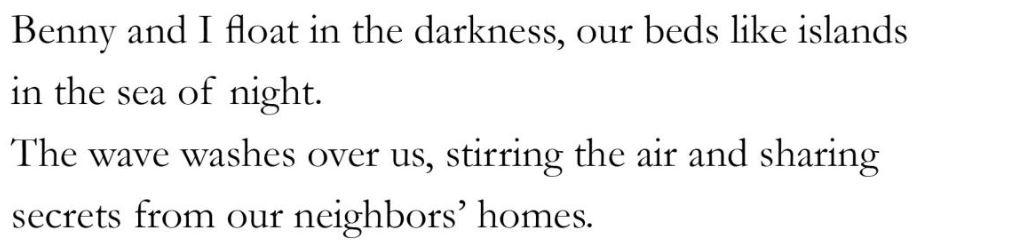
Just off the top of my head, I'm thinking Strategy 6.13: Show, Don't Tell: Using Senses to Describe Places from the Serravallo Writing Strategies book, as well as 6.14: Show, Don't Tell: Emotions. You can also definitely find a mentor sentence here to suit your students' needs, as in 6.38: Mentor Sentences.
For Goal7: Word Choice, 7.4: Bring Objects to Life, 7.5 Verbs That Match the Meaning, and definitely 7.8: Sneaky Sounds: Alliteration, Consonance and Assonance.
The more you return to a particular mentor text, the more students (and you!) will understand how that text works and how you can edit your writing by using the mentor text example.
And A Wave Came Through Our Window is just plain darn beautiful descriptive writing you and your kids will love.
I'm getting my copy of this book as soon as I get my first check of the school year. I think you'll want to do the same.
Showing posts with label jennifer serravallo. Show all posts
Sunday, August 18, 2019
Saturday, August 3, 2019
Summer is for Reading! Islandborn
Islandborn (2018) is a longer picture book* by Junot Díaz, illustrated most wonderfully by Leo Espinosa. Mr. Díaz was born in the Dominican Republic like his main character, immigrating to the United States as a young child, making this an #OwnVoices book.
Teachers, this story could be just taken at surface level for younger readers. A young girl, whose family is from the Dominican Republic, interviews family and community members about the island for a class project. It could be taken as just that - a story of fitting in, being proud of where you come from, learning about where you come from.
For readers at about Levels M-P(ish), it could also make a great reading and writing mentor text for vivid setting and the effect on the main character (Goal 5.22 in Jennifer Serravallo's The Reading Strategies Book), fitting in beautifully with Lucy Calkins' Reading and Writing Units of Study.
Look at Lola totally immersed in writing about the beautiful island her family and neighbors have told her about. She takes pieces from each of their descriptions. Bats "as big as blankets", beaches that "are poetry", an island exploding with music and color. Everyone shares wonderful, vivid memories with Lola.
And you can even discuss . . . the monster!
And on that note, this book can be so amazing instructionally! Because, see, that monster is everything.
For more sophisticated readers (up to Z+), you'll definitely want to discuss theme (start with theme vs plot, if your students need that). But then, this book lends itself beautifully to thinking deeply about theme, and forces the reader to infer: What is that monster? What could that monster represent and why? I love that the author never answers that for the reader.
This text connects directly to thinking about the real world in a text (7.15 in The Reading Strategies book), and to history. Although the monster could represent a number of fears according to the author, to middle grade and/or high school students, it can tie directly to Dominican dictator Trujillo's Parsely Massacre of Haitians in the Dominican Republic in the late 1930s. In this light, you'd want to ask your students why this story matters, what is the social/historical impact of that time? This book? Beautiful tie-in with historical political conflict, power, or Latin American Studies.
For all of that, this book is a light-filled, colorful triumph of joy. Author's craft - word choice for sure, illustrator's craft and impact, making inferences, questioning, all within a framework that will validate so many of our students.
*Special appreciation and shout out to Dial Books for Young Readers for taking a chance and publishing a LONGER PICTURE BOOK! Yay!!! 48 pages! We've been waiting for a return to longer picture books, and I hope this beauty ushers in many more.
Teachers, this story could be just taken at surface level for younger readers. A young girl, whose family is from the Dominican Republic, interviews family and community members about the island for a class project. It could be taken as just that - a story of fitting in, being proud of where you come from, learning about where you come from.
For readers at about Levels M-P(ish), it could also make a great reading and writing mentor text for vivid setting and the effect on the main character (Goal 5.22 in Jennifer Serravallo's The Reading Strategies Book), fitting in beautifully with Lucy Calkins' Reading and Writing Units of Study.
Look at Lola totally immersed in writing about the beautiful island her family and neighbors have told her about. She takes pieces from each of their descriptions. Bats "as big as blankets", beaches that "are poetry", an island exploding with music and color. Everyone shares wonderful, vivid memories with Lola.
![]() |
| Lola in 'the zone' |
![]() |
| Lola's writing exploding from the page for her class at the end of the story |
And you can even discuss . . . the monster!
And on that note, this book can be so amazing instructionally! Because, see, that monster is everything.
For more sophisticated readers (up to Z+), you'll definitely want to discuss theme (start with theme vs plot, if your students need that). But then, this book lends itself beautifully to thinking deeply about theme, and forces the reader to infer: What is that monster? What could that monster represent and why? I love that the author never answers that for the reader.
This text connects directly to thinking about the real world in a text (7.15 in The Reading Strategies book), and to history. Although the monster could represent a number of fears according to the author, to middle grade and/or high school students, it can tie directly to Dominican dictator Trujillo's Parsely Massacre of Haitians in the Dominican Republic in the late 1930s. In this light, you'd want to ask your students why this story matters, what is the social/historical impact of that time? This book? Beautiful tie-in with historical political conflict, power, or Latin American Studies.
For all of that, this book is a light-filled, colorful triumph of joy. Author's craft - word choice for sure, illustrator's craft and impact, making inferences, questioning, all within a framework that will validate so many of our students.
![]() |
| My favorite spread. Together they vanquished the monster. Hope and joy. |
*Special appreciation and shout out to Dial Books for Young Readers for taking a chance and publishing a LONGER PICTURE BOOK! Yay!!! 48 pages! We've been waiting for a return to longer picture books, and I hope this beauty ushers in many more.
Subscribe to:
Posts (Atom)


