Pages

Showing posts with label african american main characters. Show all posts

Sunday, August 18, 2019

Summer Is For Reading! A Wave Came Through Our Window

Wow. A Wave Came Through Our Window (2015) by Zetta Elliott is a book that teachers will want to make sure to use as a fabulous mentor text for teaching writing.


Not only is this text a perfect fit for teaching 'small moments' in writing (particularly fits well with that in the Lucy Calkins' Writing Units of Study), but is phenomenal as examples to illustrate author's word choice.

Through engaging characters that our brown students can relate to, this book will help you show students by example how to hone in on that small, meaningful moment to write about. The author didn't choose to write about an entire summer and how hot it was; she chose to hone in on what one summer night in their hot apartment was like. And not just one night in their apartment, but one night at bedtime!

If you or your school uses Jennifer Serravallo's Writing Strategies book, this fits perfectly with Goal 4: Focus/Meaning. Within Goal 4, you may want to use this as a mentor text for Strategy 4.5: Write About a Pebble or 4.6: Zoom In On A Moment of Importance.

You'll also definitely want to use this book as a mentor text for Author's Craft. In Jennifer Serravallo's Writing Strategies book, you can see this book fits very well as a mentor text for Goal 6: Elaboration and Goal 7: Word Choice.


Check out those similes, sensory details "... warm and thick ..." and use of rhyme, "...turns and churns..."!


Below are a few more excerpts. See if you can spot the similes, sensory details and alliteration.
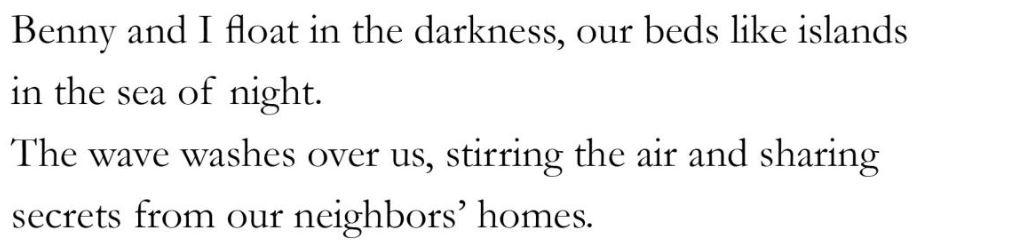


Just off the top of my head, I'm thinking Strategy 6.13: Show, Don't Tell: Using Senses to Describe Places from the Serravallo Writing Strategies book, as well as 6.14: Show, Don't Tell: Emotions. You can also definitely find a mentor sentence here to suit your students' needs, as in 6.38: Mentor Sentences.

For Goal7: Word Choice, 7.4: Bring Objects to Life, 7.5 Verbs That Match the Meaning, and definitely 7.8: Sneaky Sounds: Alliteration, Consonance and Assonance.

The more you return to a particular mentor text, the more students (and you!) will understand how that text works and how you can edit your writing by using the mentor text example.

And A Wave Came Through Our Window is just plain darn beautiful descriptive writing you and your kids will love.

I'm getting my copy of this book as soon as I get my first check of the school year. I think you'll want to do the same.


Wednesday, July 31, 2019

Summer Is For Reading! Jabari Jumps

Oh, be still my heart! Jabari. 💓

I was lucky enough to be able to order a six-pack of Jabari Jumps by Gaia Cornwall (2017) for our school's book room in the spring of 2017.

Teachers, if your school does not have this book, please remedy that!

This is one of those picture books that can be used on multiple levels for Kindergarteners through high school, depending on your instructional purpose. The text is deceptively simple. But don't underestimate Jabari!

For the littlest ones, it's a feel-good story about being brave, rich with family love. I read this to one of my second grade reading groups to test the waters (pun intended). K, a young man with learning and focus challenges who struggled to comprehend and retell most stories, told us everything after I read it to them. He told it all! Not just events, but feelings of the main characters, possible reasons - K made good inferences.

My favorite spread

Representation matters. In this 'simple' book about a little boy facing his fear of jumping off the diving board, bolstered by his father's love and support, K saw himself. He was literally quivering with excitement. This book mattered to him. (Not only that, but let me just point out the obvious - a functional Black family, a Black dad's love and care for his children, a Black family not just at the pool but taking swimming lessons, passing swimming tests - sadly, it's a thing that people think Black families don't do this - all of this matters.)

Above, you see my favorite spread. Look at those sweet characters - Jabari standing there just like little boys do, holding his daddy's hand. That baby girl's arm going around her daddy's back. Daddy has all his kid-care supplies in his backpack for the day.

And then read that last sentence. "But when his dad squeezed his hand, Jabari squeezed back." That is an entire mini-lesson's worth of instruction for third grade through high school right there! That is the pivot point in the book, the author dropping us a clue, the author's choice of character action - can your students analyze that sentence? Did they even notice it?  (This is CCSS R.5)

Those are the discussions you'd want to be sure to have with students reading about on Levels O - Z+ (mid-third grade and up).

You'll also want to use this book as a great model (because of its depth of complexity and its short reading time) for understanding the deeper nuances of character and theme with upper elementary through high schoolers. If you are a fan and user of Jennifer Serravallo's The Reading Strategies Book, Jabari Jumps would be a great mentor text for just about all of Goal 7 that marries character and theme.

Difference between plot and theme? Quick and easy with this book. Also from Serravallo's Goal 7, you can use this text for lessons on what we can learn from how characters treat each other, seed to theme, character change reveals lessons, secondary sages, aha moment, and titles (is "Jabari Jumps" literal or is there more to it?). All of these fall within CCSS R.2 and R.3, theme and characters. Great for small group lessons on all of these skills.

Look at the spread below. We've all been there.


But could we take that more than literally with this story? What could this be a metaphor for, both in the text and in the larger context of community, the world?

And then there's the art.


Look how Cornwall uses what looks to be old book text to form the city buildings. Why did she choose to do that? What is the impact on the story? The reader? CCSS Anchor Standard R.7.

Get Jabari Jumps. You'll love it as much as I do.

Saturday, July 13, 2019

Summer is for Reading! Dragons In A Bag

Summer is for reading!

I just finished reading Zetta Elliott's Dragons In A Bag (2018), a young middle-grade fantasy novel. And check out the cover:


Notice anything unusual? As a teacher or parent or family member of young readers, did you know that it is unusual to find African American/Black main characters in fantasy books?

Teachers, this book will welcome all the fantasy lovers in your classroom. Jaxon's time travel and dragon chasing will resonate with all fantasy geeks (like me) and Elliott's authenticity with her main characters will definitely be appreciated by African American/Black young readers. What's that? Your students are mostly White? Even more reason to add this to your classroom library. African American/Black fantasy main characters need to be normalized for White kids.

Although I couldn't find a guided reading level officially for this book, I'd estimate it at a Level N, which puts it smack in the middle of third grade. However, fourth and fifth grade teachers, you should definitely add this to your classroom libraries too (especially if you do a fantasy unit) - not just for our lower level readers, but because on- and above-grade level readers also need to read this and either feel themselves or feel African American/Black fantasy main characters normalized. And all students will enjoy the characters and plot.