Pages

Wednesday, January 26, 2022

Words

Words

by Kara Stewart

The words are stuck

jammed

wedged 

somewhere in my throat, all jagged points 

thrust

into soft inner

flesh.


They won’t come out

They aren’t even the right ones

They are only the most used, most familiar, after decades of 

ignoring 

the dictionary,

the language


They are sloppy, rough 

patches 

slapped onto deep wounds


Instead of 

tiny, delicate stitches made with exactly

the

right

thread and exactly 

the

right

needle.


My brain wracks, trembles, groans

to find the delicate stitches,

the right thread;

stomps and storms in

frustration

at words trundled in its

corners,

hidden. 


I can smell them,

hiding.


Saturday, January 15, 2022

Who Are You?

The barn is on fire. Blazing flames wallop out of the open double doors in front; they shoot jagged golden triangles through the small upper window used to haul hay. They send spiraling sparks into the night sky. Red paint, already weathered and worn from years of sun and rain, peels its final layers into red and black curls of charred embers and slides down the wooden siding. 


Who are you?


Do you lead the horse through the barn doors to safety, emerging from the smoke and flames into the cold night air? Do you whisper soothingly into its mane as it dances sideways, feeling the heat of the flames on its flanks? Does smoke lift off your sweater; do sparks crackle in your hair? Did you hastily throw your jacket over the horse’s eyes when you reached its stall because you knew it would panic if it saw the flames rising closer, closer? 


Who are you?


Are you whickering nervously as unnatural heat grazes your flanks? Do your eyes roll in fear, nostrils widen as you smell acrid smoke, see the flames shooting skyward? You want to bolt. You cannot. You are trapped. You scream and toss your head. You dance sideways. Dark softness is tossed over your eyes and wrapped around your head. In the dark, you can breathe. As long as you do not see the flames of reality, as long as you are helped to ignore them, you can be coaxed to move. 


Who are you?


Are you on the hill outside the barn, under the stars, mouth open in horror, eyes reflecting sharp yellow flames? Do you hug your arms around yourself, not trusting what you see to be true? Do you stare in silent shock at the ones shouting directions that are unheard, unheeded, unnecessary? 


Do you shout directions: unheard, unheeded, unnecessary?


Who are you?


Are you frantically lined from barn to farmhouse, passing thimbles of water to throw on the two-story wall of flames? Do you snatch each bucket with furious speed and shove it to the next in line, water sloshing over the top? Does your adrenaline pump so full and fast that you barely feel your arms, your hands, for the millisecond they grip each heavy bucket? Do you move through the horror with desperate, defeated action while a corner of your mind, the corner you keep hidden even from yourself, knows these Herculean efforts will not stop the barn from ending up a smoldering heap tomorrow?


Who are you?


Are you in the house, calling 911, making redolent pots of strong coffee and keeping the children safely inside? Do you soothe and shush the littlest ones and tell them, "Go back to bed, everything is fine." It is a lie, you know it as you say the words but you tell yourself they will believe. Do you take towels out of the linen closet and stack them by the sinks? Pace back and forth because you still don’t hear the rescue sirens coming to put the fire in your beloved barn out for good? Where is the fire engine, where is the fire engine, you wonder. Why aren’t they coming? What is taking so long?


Who are you?


Did you sneak out of the back door into the night that should be black but is lit up like a permanent firecracker? Are you crouching down, watching in your thin pajamas, shivering, unseen, hugging your dog's warm familiarity close? Are the flames oddly beautiful as their bright sparks circle into the black sky? Can you hear the whoosh from the force of the fire pushing out of the barn? Do you wonder if anyone else hears it? No one does. Just you. Always just you. You shiver and pull your friend closer, not from fear of the flames, but from cold.


Who are you?


Do you stay close to your human as she slips from her bed and sneaks out the back door? Do you sit next to her, pushing your strong shoulder blade into her to steady her? Do you give her cheek a quick lick and settle into her lap to warm her as she pulls you in? Do you smell the smoke, hear the whoosh from the force of the fire and know you must stay with your small human? But she is a smart girl. She will not go near the flames. Not this kind anyway. 


Who are you?


Do the flames burn through you like hell’s own dragon? Do they shoot out your eyes, razing everything within, from the most delicate, soft pink mousling heart nests to rough, rusty saw blades hanging on your walls? Do the flames destroy you from the inside out? Will they be the end of you and all you held dear in your comfortable sheltering walls? Do they destroy those within and those without, all in different measure? Do you burn with fury, knowing you will be a pile of rubble tomorrow, wisping white smoke rising from your belly? 


Who are you?


Does the tip of your cigarette flare red as you breathe it to life? Do you toss your lighter across the ditch, into the frosty field, far from your rusty pick up? Do you open the creaking door, climb into the cab, and take a couple of cranks to start the engine? You look in your rearview mirror across the fields and hills at the glowing roar of the barn through the darkness, shrinking to a pinprick as you drive away, billows of white exhaust lingering behind you. Do you grunt in satisfaction? Or dismiss that chapter without a second thought?


Who are you?


Tuesday, September 10, 2019

Summer Is For Reading! Apple in the Middle

Apple in the Middle, Dawn Quigley's debut novel, is a Young Adult (I'd say young YA or even upper MG) coming of age story whose main character is Turtle Mountain Band of Ojibwe, just like the author.

Publisher's Synopsis:
"Apple Starkington turned her back on her Native American heritage the moment she was called a prairie nigger-a racial slur for someone of white and Indian descendance-not that she really even knows how to be an Indian in the first place. Too bad the white world doesn't accept her either. After her wealthy father gives her the boot one summer, Apple reluctantly agrees to visit her Native American relatives on the Turtle Mountain (North Dakota) Indian Reservation for the first time. It should have been easy, except that she makes all kinds of mistakes as she deals with the culture shock of Indian customs and the Native Michif language, while trying to find a connection to her dead mother. She also has to deal with a vengeful Indian man, Karl, who has a violent, granite-sized chip on his shoulder because he loved her mother in high school but now hates Apple because her mom married a white man. As Apple meets her Indian relatives this summer, she finds that she just may have found a place to belong. One by one, each character-ranging from age five to eighty-five-teaches her, through wit and wisdom, what it means to be a Native person, but also to be a human being while finding her place in the world. Apple shatters Indian stereotypes and learns what it means to find her place in a world divided by color."
Apple in the Middle

Remember those days of junior high (dating myself here, I should say middle school, perhaps) when so many of us felt completely socially inept and were the biggest misfits ever? That's Apple, the main character. Socially awkward kids - no matter their personal race or culture - will welcome reading about someone just as awkward. 

Additionally, Apple's identity struggle is something Native kids (and adults!) will relate to. Identity issues (a result of 500 years of non-Natives telling Natives what they are or aren't, which is in conflict with what Natives really are or aren't) are a big player in Native psyches and have many ramifications, and can be magnified when the person is mixed race or biracial, as is Apple. 
Apple says, "I call it the Ping-Pong effect because you’re the ball, and nobody ever wants you in their space. Have you ever felt like that? Never really belonging anywhere, but trying your darndest to run between two lives only to find you’re always stuck in the middle.”
Yes, Apple, yes, I have felt like that. All my life.

For elementary teachers or parents, although I can't find an official guided reading level on this book, I'd put it at about a T, definitely within the grasp of 4th or 5th grade classroom libraries. You can also use it to follow or teach character development. But its highest use for you will be to read it yourself. It will help inform so many other things you do around Native people for the rest of your teaching career (keeping in mind that there are well over 500 federally recognized tribes in the U.S. and many state-recognized tribes also, and that this is a story from one of those tribes). You will gain insight into some common Native issues as well as learn about the Turtle Mountain Band of Ojibwe through informative sections sprinkled throughout the book. 

As Jean Mendoza points out in her review of Apple in the Middle on American Indians in Children's Literature, there are also several other recent #OwnVoices books that you should read with that same goal of informing your teaching, such as Cynthia Leitich Smith's Hearts Unbroken and the graphic novel series, Pemmican Wars, by Katherena Vermette

For middle school or high school teachers or parents, I'd echo the same highest use and further reading, and additionally challenge you to include your learning from this book in your American History and other related Social Studies Essential Standards. I would go into detail, but just now, reading over my state's NC Essential Standards, I am so disgusted at how we are left out that I can't bring myself to list the million ways you could infuse courses with accurate content about Native people. Disclaimer: I'm Native (Sappony), in case you didn't know. But why should that matter or change anything I just said?

We need so many more books like Apple in the Middle. I look forward to Dawn Quigley's next books!


Sunday, August 18, 2019

Summer Is For Reading! A Wave Came Through Our Window

Wow. A Wave Came Through Our Window (2015) by Zetta Elliott is a book that teachers will want to make sure to use as a fabulous mentor text for teaching writing.


Not only is this text a perfect fit for teaching 'small moments' in writing (particularly fits well with that in the Lucy Calkins' Writing Units of Study), but is phenomenal as examples to illustrate author's word choice.

Through engaging characters that our brown students can relate to, this book will help you show students by example how to hone in on that small, meaningful moment to write about. The author didn't choose to write about an entire summer and how hot it was; she chose to hone in on what one summer night in their hot apartment was like. And not just one night in their apartment, but one night at bedtime!

If you or your school uses Jennifer Serravallo's Writing Strategies book, this fits perfectly with Goal 4: Focus/Meaning. Within Goal 4, you may want to use this as a mentor text for Strategy 4.5: Write About a Pebble or 4.6: Zoom In On A Moment of Importance.

You'll also definitely want to use this book as a mentor text for Author's Craft. In Jennifer Serravallo's Writing Strategies book, you can see this book fits very well as a mentor text for Goal 6: Elaboration and Goal 7: Word Choice.


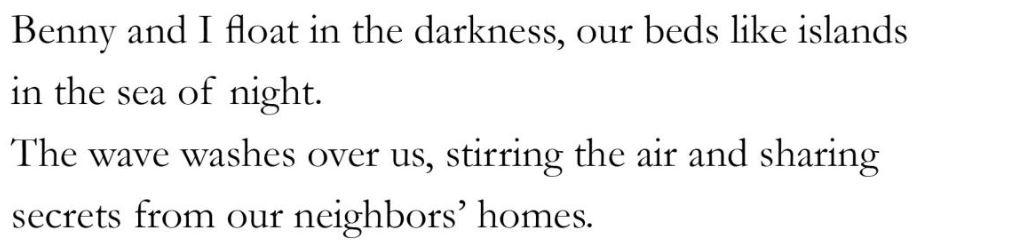
Check out those similes, sensory details "... warm and thick ..." and use of rhyme, "...turns and churns..."!


Below are a few more excerpts. See if you can spot the similes, sensory details and alliteration.


Just off the top of my head, I'm thinking Strategy 6.13: Show, Don't Tell: Using Senses to Describe Places from the Serravallo Writing Strategies book, as well as 6.14: Show, Don't Tell: Emotions. You can also definitely find a mentor sentence here to suit your students' needs, as in 6.38: Mentor Sentences.

For Goal7: Word Choice, 7.4: Bring Objects to Life, 7.5 Verbs That Match the Meaning, and definitely 7.8: Sneaky Sounds: Alliteration, Consonance and Assonance.

The more you return to a particular mentor text, the more students (and you!) will understand how that text works and how you can edit your writing by using the mentor text example.

And A Wave Came Through Our Window is just plain darn beautiful descriptive writing you and your kids will love.

I'm getting my copy of this book as soon as I get my first check of the school year. I think you'll want to do the same.


Sunday, August 11, 2019

Summer Is For Reading! We Are Grateful Otsaliheliga

Elementary teachers, Traci Sorell's lyrically beautiful, multi-award-winning We Are Grateful Otsaliheliga (2018) is just what you are looking for.


Summary from the author's website:
Otsaliheliga (oh-jah-LEE-hay-lee-gah) is a word that Cherokee people use to express gratitude. Beginning in the fall with the Cherokee New Year and ending in summer, follow a full Cherokee year of celebrations and experiences. Written by Traci Sorell, a citizen of the Cherokee Nation, and illustrated by Frané Lessac, this nonfiction look at one group of Native Americans is appended with a glossary and the complete Cherokee syllabary, originally created by Sequoyah.

UP FRONT NOTE: There are two main federally-recognized Cherokee tribes. Traci Sorell is from the Oklahoma Cherokee Nation and her book is from that setting, perspective and research. Points in her book may vary from the Eastern Band of Cherokee Indians' culture and history here in North Carolina. Oklahoma and North Carolina teachers and librarians, especially, should be aware of these distinctions. It would be interesting to have students compare and contrast the two through the lens of We Are Grateful.


Teachers, We Are Grateful Otsaliheliga lends itself to teaching main idea and supporting details (boxes and bullets in the non-fiction reading unit if you use Lucy Calkins' Reading Units of Study) for second through probably fourth grade. You'll find this in Jennifer Serravallo's Reading Strategies book, Strategy 8.5, Boxes and Bullets. This would be particularly useful for third grade at my school. For kindergarten and first graders, or students who aren't quite ready to determine what a book is mostly about, this is also a good fit for Goal 8.3, Notice What Repeats.

You'll also want to be sure to teach students to analyze the information presented. Your students can critically analyze the traits the author writes about the Cherokee, the take-away, and why the author believes this story was important to write. In the Reading Strategies book, Strategy 8.15, Why Does the Story Matter? will help you do that.

Additionally, this is a great book to teach text structure because of its seasonal, cyclical structure with plenty of text feature clues. This text could be either description structure (main idea/detail) or sequence but as a circle, not a timeline.

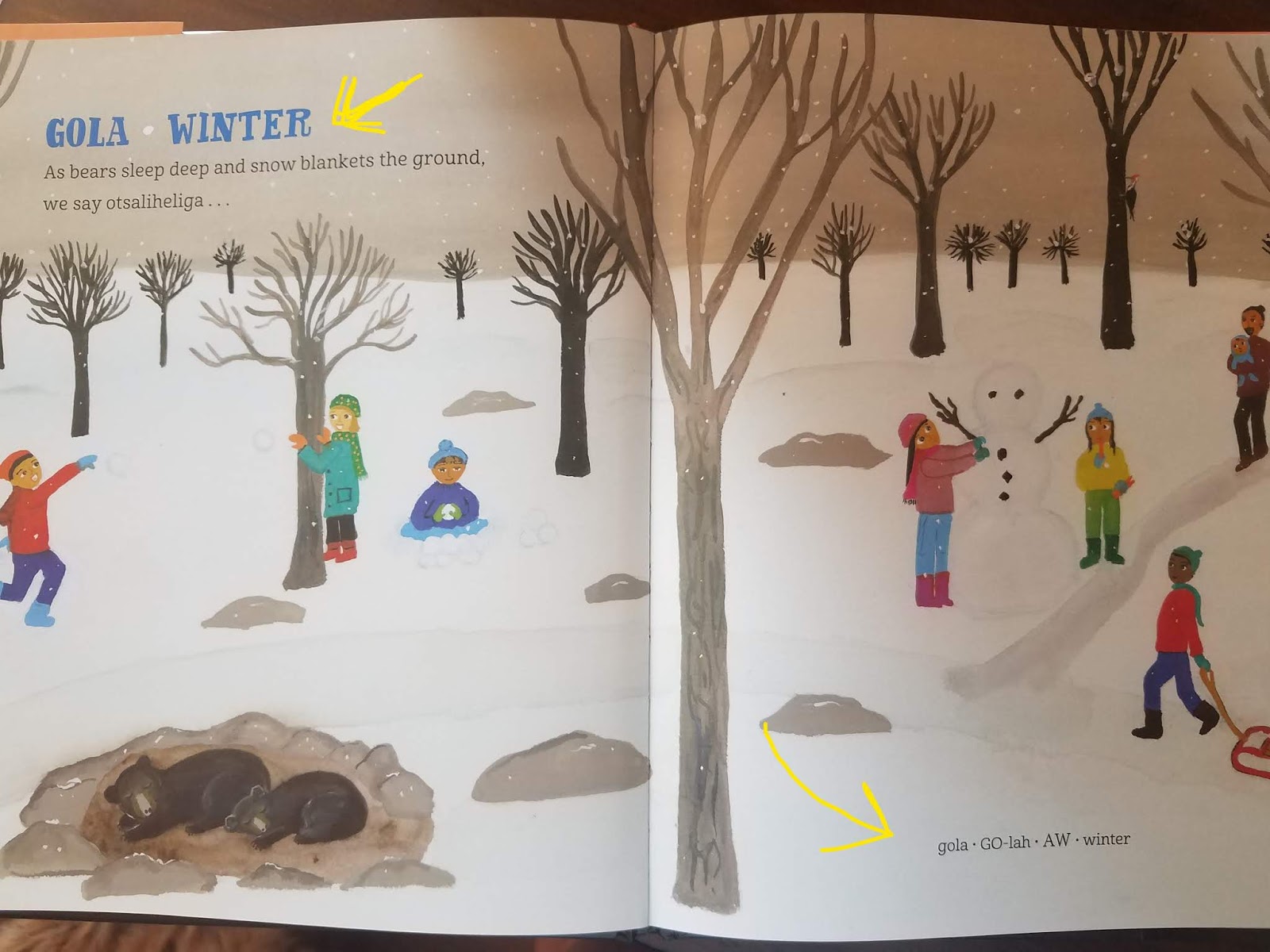
I love illustrator Lessac's four-season tree on the opening page.
This page orients readers to the rest of the book.

The header (top left) makes this an easy model for text structure.
At bottom right, this pronunciation guide is just one of the text features.
All that being said, this is clearly a book elementary teachers will want to use at Thanksgiving in place of problematic books that promote stereotypes but are so commonly used at that time.

We Are Grateful is an #OwnVoices accurate representation of Native life. The author refers to the Cherokee in the present-tense, not as extinct or stuck in history. The illustrator's art also depicts contemporary Native people. And the theme is one that we all want to teach young students: gratitude.

While I would never want to pigeon-hole this book as a 'Thanksgiving book', it really is an excellent substitute for books that we may have used for years, but that actually promote stereotypes.

For more information on accurate teaching about Thanksgiving, please see the North Carolina State Advisory Council on Indian Education's Teaching About Thanksgiving page.

If you are a teacher in North Carolina, the entire SACIE Culturally Responsive Instructional Resources website was made into a for-credit pd module two years ago. You can access it the same way you access your PDP.  NCEdCloud -->NCEES. Then Professional Development tab at the top, then Course Search for #8048 Culturally Responsive Teaching About American Indians: Self-Paced. Please take this course! Huge amount of learning resources that will pay off in your classroom. Plus, you can do it in your pjs. 😉

For more information (you can even plug a book title into the search bar) on kidlit and accurate Native representation, please see Debbie Reese's amazing blog, American Indians in Children's Literature.

Teachers and librarians, please make sure this book is in your school!

Men cuddling babies? Yes, please!


Saturday, August 10, 2019

Summer Is For Reading! The Night Diary

The Night Diary (2019) by Veera Hiranandani is the 2019 Newbery Honor Book, as well the winner of a host of other awards, and a masterful piece of art.

In high school, I remember learning about the separation of India and Pakistan, and about Ghandi and his teachings. I remember seeing photographs of trains filled beyond capacity, people on roofs, people hanging out windows, trains packed full of people tighter than sardines, to reach India or Pakistan.

But the human cost of that political decision on the daily lives of millions of people escaped me because it was not taught in History or heaven forbid, in English Language Arts.

Teachers, this #OwnVoices middle grade novel (I'd narrow it down as late middle grade and recommend it for grades 6 - 12) will remedy that situation for your students.

Publisher's summary:

It's 1947, and India, newly independent of British rule, has been separated into two countries: Pakistan and India. The divide has created much tension between Hindus and Muslims, and hundreds of thousands are killed crossing borders
Half-Muslim, half-Hindu twelve-year-old Nisha doesn't know where she belongs, or what her country is anymore. When Papa decides it's too dangerous to stay in what is now Pakistan, Nisha and her family become refugees and embark first by train bu later on foot to reach her new home. The journey is long, difficult, and dangerous, and after losing her mother as a baby, Nisha can't imagine losing her homeland, too. But even if her country has been ripped apart, Nisha still believes in the possibility of putting herself back together. 
Told through Nisha's letters to her mother, The Night Diary is a heartfelt story of one girls' search for home, for her own identity... and for a hopeful future.

The teaching points for history are obvious and I'd definitely recommend history/social studies/world cultures teachers use this book. But I'd also highly recommend it for ELA teachers, and ideally, for ELA and history teachers to coordinate efforts to use this book for instruction.

There is a fabulously detailed, well-thought-out teacher's guide on the publisher's website with complex thinking points and Common Core Standards alignment. Definitely use that.

But what stood out to me as I read it is character analysis. Not just having complex characters to teach students to analyze to meet standards, but characters that will resonate with your students and empower them.

Do you have students that are very hesitant to speak except to one or two other people? It feels like you must slowly draw them out every day to get responses from them? They will be relieved and intrigued to recognize themselves in Nisha.

Do you have students who struggle to read and write? Whose gifts may not be recognized by all? They will understand Amil's struggles and triumphs.

Do you have students who need to begin to understand the personal, human toll of politics? Who need a way to unpack and reframe social justice issues? Who need to learn about daily life, food and customs in other countries? (That would be everybody.)

Do you have students who need to analyze true historical world events in light of today's world events? (Again, everybody.)
"I heard Papa telling Dadi there are riots everywhere and, if we don't leave, we could be killed or taken to a refugee camp. Who would do this? Our neighbors? The kids we went to school with? The merchants at the market? Patients who Papa treated at the hospital? My teacher? Dr. Ahmed? Papa says that everyone is killing one another now, Hindus, Muslims, Sikhs. Everyone is to blame. He says that when you separate people into groups, they start to believe that one group is better than another."
Middle school and high school teachers, please buy, or ask your district to buy, this book and use it for instruction. It's a gem.


Saturday, August 3, 2019

Summer is for Reading! Islandborn

Islandborn (2018) is a longer picture book* by Junot Díaz, illustrated most wonderfully by Leo Espinosa. Mr. Díaz was born in the Dominican Republic like his main character, immigrating to the United States as a young child, making this an #OwnVoices book.

Teachers, this story could be just taken at surface level for younger readers. A young girl, whose family is from the Dominican Republic, interviews family and community members about the island for a class project. It could be taken as just that - a story of fitting in, being proud of where you come from, learning about where you come from. 

For readers at about Levels M-P(ish), it could also make a great reading and writing mentor text for vivid setting and the effect on the main character (Goal 5.22 in Jennifer Serravallo's The Reading Strategies Book), fitting in beautifully with Lucy Calkins' Reading and Writing Units of Study.

Look at Lola totally immersed in writing about the beautiful island her family and neighbors have told her about. She takes pieces from each of their descriptions. Bats "as big as blankets", beaches that "are poetry", an island exploding with music and color. Everyone shares wonderful, vivid memories with Lola.


Lola in 'the zone'

Lola's writing exploding from the page for her class at the end of the story

And you can even discuss . . . the monster!


And on that note, this book can be so amazing instructionally! Because, see, that monster is everything. 

For more sophisticated readers (up to Z+), you'll definitely want to discuss theme (start with theme vs plot, if your students need that). But then, this book lends itself beautifully to thinking deeply about theme, and forces the reader to infer: What is that monster? What could that monster represent and why? I love that the author never answers that for the reader.

This text connects directly to thinking about the real world in a text (7.15 in The Reading Strategies book), and to history. Although the monster could represent a number of fears according to the author, to middle grade and/or high school students, it can tie directly to Dominican dictator Trujillo's Parsely Massacre of Haitians in the Dominican Republic in the late 1930s. In this light, you'd want to ask your students why this story matters, what is the social/historical impact of that time? This book? Beautiful tie-in with historical political conflict, power, or Latin American Studies.

For all of that, this book is a light-filled, colorful triumph of joy. Author's craft - word choice for sure, illustrator's craft and impact, making inferences, questioning, all within a framework that will validate so many of our students. 


My favorite spread. Together they vanquished the monster. Hope and joy.


*Special appreciation and shout out to Dial Books for Young Readers for taking a chance and publishing a LONGER PICTURE BOOK!  Yay!!! 48 pages! We've been waiting for a return to longer picture books, and I hope this beauty ushers in many more. 


Wednesday, July 31, 2019

Summer Is For Reading! Jabari Jumps

Oh, be still my heart! Jabari. 💓

I was lucky enough to be able to order a six-pack of Jabari Jumps by Gaia Cornwall (2017) for our school's book room in the spring of 2017.

Teachers, if your school does not have this book, please remedy that!

This is one of those picture books that can be used on multiple levels for Kindergarteners through high school, depending on your instructional purpose. The text is deceptively simple. But don't underestimate Jabari!

For the littlest ones, it's a feel-good story about being brave, rich with family love. I read this to one of my second grade reading groups to test the waters (pun intended). K, a young man with learning and focus challenges who struggled to comprehend and retell most stories, told us everything after I read it to them. He told it all! Not just events, but feelings of the main characters, possible reasons - K made good inferences.

My favorite spread

Representation matters. In this 'simple' book about a little boy facing his fear of jumping off the diving board, bolstered by his father's love and support, K saw himself. He was literally quivering with excitement. This book mattered to him. (Not only that, but let me just point out the obvious - a functional Black family, a Black dad's love and care for his children, a Black family not just at the pool but taking swimming lessons, passing swimming tests - sadly, it's a thing that people think Black families don't do this - all of this matters.)

Above, you see my favorite spread. Look at those sweet characters - Jabari standing there just like little boys do, holding his daddy's hand. That baby girl's arm going around her daddy's back. Daddy has all his kid-care supplies in his backpack for the day.

And then read that last sentence. "But when his dad squeezed his hand, Jabari squeezed back." That is an entire mini-lesson's worth of instruction for third grade through high school right there! That is the pivot point in the book, the author dropping us a clue, the author's choice of character action - can your students analyze that sentence? Did they even notice it?  (This is CCSS R.5)

Those are the discussions you'd want to be sure to have with students reading about on Levels O - Z+ (mid-third grade and up).

You'll also want to use this book as a great model (because of its depth of complexity and its short reading time) for understanding the deeper nuances of character and theme with upper elementary through high schoolers. If you are a fan and user of Jennifer Serravallo's The Reading Strategies Book, Jabari Jumps would be a great mentor text for just about all of Goal 7 that marries character and theme.

Difference between plot and theme? Quick and easy with this book. Also from Serravallo's Goal 7, you can use this text for lessons on what we can learn from how characters treat each other, seed to theme, character change reveals lessons, secondary sages, aha moment, and titles (is "Jabari Jumps" literal or is there more to it?). All of these fall within CCSS R.2 and R.3, theme and characters. Great for small group lessons on all of these skills.

Look at the spread below. We've all been there.


But could we take that more than literally with this story? What could this be a metaphor for, both in the text and in the larger context of community, the world?

And then there's the art.


Look how Cornwall uses what looks to be old book text to form the city buildings. Why did she choose to do that? What is the impact on the story? The reader? CCSS Anchor Standard R.7.

Get Jabari Jumps. You'll love it as much as I do.

Monday, July 22, 2019

Summer is for Reading! Awâsis and the World-Famous Bannock

Teachers, Awâsis and the World-Famous Bannock (2018) is one of those books that will make teaching easier! Quadruple duty: theme/central message, analysis of two or more texts, stories from diverse cultures & global goals, and author's craft.


Awâsis and the World-Famous Bannock by Dallas Hunt, illustrated by Amanda Strong, is an #OwnVoices picture book. It's also recommended by Debbie Reese on her blog American Indians in Children's Literature. The main character, Awâsis, gets help from some animal friends after accidentally dropping her grandmother's bannock. 

Short reads, especially picture books, are great to model think-alouds for K-12. Since they are short, they get across the teaching point through example quickly, and illustrations make them memorable for students all the way through high school (and beyond). Additionally, if you use the same text to help teach multiple standards, students will become more deeply familiar with that text and thus more familiar with how to think deeply about a text.

This short read would be great to model theme and central message (RL.2), especially for 2nd through 8th grades, and even more so if your grade level standard mentions 'diverse cultures' (2nd and 3rd grades here in North Carolina). Awâsis and the World-Famous Bannock also has a guide to included words in the Cree language in the back, and you can also watch this video with your students to learn the words together!

Is your school a global school? If your grade level learns about North America, this would be a perfect text to combine global goals with ELA standards.

Awâsis and the World-Famous Bannock would also be fabulous to use to teach RL.9 - analyzing two or more texts. Below, these grade levels' RL.9 would be a great fit for this book:

RL.2.9 Compare and contrast two or more versions of the same story by different authors or from different cultures.

RL.4.9 Compare and contrast the use of similar themes and topics and patterns of events in stories, myths, and traditional literature from different cultures.
RL.5.9 Compare and contrast stories in the same genre on their approaches to similar themes and topics.
RL.6.9 Compare and contrast texts in different forms or genres in terms of their approaches to similar themes and topics.
RL.8.9 Analyze how a modern work of fiction draws on themes, patterns of events, or character types from myths, traditional stories, or religious works, including describing how the material is rendered new.

There are a couple of texts that students could compare to Awâsis and the World-Famous Bannock. Little Red Riding Hood would be a traditional story that students would find an interesting comparison (mother/grandma sends girl on a mission through the forest to help relatives in both stories, mission fails in both stories, girl meets animal in the forest, animals are helpful in one story, not in the other - lots of possibilities). 

The other great comparison text that springs to mind is Cynthia Leitich Smith's Jingle Dancer, in which the main character goes from relative to relative collecting jingles for her jingle dress to dance in the powwow for her relatives. (If you don't have Jingle Dancer, get it - it's phenomenal!)


Theme comparison would involve differences: listen to your parents, or do as you are told or bad things will happen vs helping others, interdependence, accepting help, working together - many possibilities.

And you know we need to insert Author's Craft whenever we can at every grade level, so check this out:


See what my pencil is pointing to? Yay! Why did the author decide to use a smaller/larger font for this part? What is the effect of the author's use of a smaller/larger font? What does the author want the reader to do when they get to the smaller/larger font? Why? 

Aaaand, the world-famous bannock recipe is in the back so you can actually make it! Science and math standards, anyone? Yum!


Monday, July 15, 2019

Summer Is For Reading! The Sockeye Mother

Summer is for reading!

I just read The Sockeye Mother (2017) by Hetxw'ms Gyetxw (Brett David Huson).


I can see so many classroom uses for this nonfiction picture book! It details the life cycle throughout the year of a sockeye salmon, a key species for the Gitxsan people of Northwestern British Columbia. I'll be adding it to my school's purchase list.

Teachers, if your third grade does the Lucy Calkins animal research unit, this book would be perfect! It would also be a great fit for ecosystem standards (fifth grade in my home state), and animal studies standards (fourth grade in my home state).

But wait, there's more! See those text features in the pic below? You know how hard we work to teach young readers how to recognize and use these in all grade levels. This book has an author's note, a map, headings and science vocabulary text boxes (as per pic below).


Beautiful artwork by Natasha Donovan also keeps young readers engaged, as does the connection to the seasons and the Gitxsan people (see pic below).


This book is remarkable in that the overarching theme is how the two species, the sockeye salmon and the people, are interconnected. Nonfiction animal fact text and theme? Yep! It's there.

Debbie Reese has a more detailed review on her blog, American Indians In Children's Literature that you should check out, too. Debbie suggests using the video that is on the Portage & Main Press site (linked above), Youtube, and also her review, to learn how to pronounce some of the Gitxsan words in the book. I'd also suggest showing the video to your students. Have fun and do your best with the words and use it as a model of your learning, along with your students!

There is also a video on Youtube of the author, Brett Huson, talking about culture, the importance of women, mothers, grandmothers, and family, as well as where the story of The Sockeye Mother came from. This is a longer, but very interesting video that teachers will want to watch/listen to and then choose parts to share with students.

Get it, teach it, love it.


Sunday, July 14, 2019

Summer is for Reading! What Jamie Saw

Summer is for reading!

I just finished reading What Jamie Saw (1995) by Carolyn Coman (Level T). It's been on my To Be Read list because I've seen it in the majority of the third, fourth and fifth grade classroom libraries at my school. It appears to have been a district purchase at one point, possibly even in multiple sets.

Teachers, I urge caution with this book. It details very graphically, and well, child abuse that a 9 year old saw and the aftermath of emotions and chaos experienced by the family.

Personally, I wouldn't put it in a classroom library for students to read on their own, especially considering that many of our students have been through this type of trauma themselves. There isn't any 'redeeming, Hail Mary, everything's okay and here's the cure to your feelings' in this book that a child who has been through similar trauma could hold onto and use to gather personal strength.

It is more a book that teachers (and social workers) could read to get a child's perspective of the emotions experienced and behavior expressed during and after critical trauma and use that knowledge to better help children who have been through it. And unfortunately, we know that there are more and more children who come to us with this in their background.

If you have What Jamie Saw in your classroom library or book room, please closely consider your chosen use for this book.


Saturday, July 13, 2019

Summer is for Reading! Dragons In A Bag

Summer is for reading!

I just finished reading Zetta Elliott's Dragons In A Bag (2018), a young middle-grade fantasy novel. And check out the cover:


Notice anything unusual? As a teacher or parent or family member of young readers, did you know that it is unusual to find African American/Black main characters in fantasy books?

Teachers, this book will welcome all the fantasy lovers in your classroom. Jaxon's time travel and dragon chasing will resonate with all fantasy geeks (like me) and Elliott's authenticity with her main characters will definitely be appreciated by African American/Black young readers. What's that? Your students are mostly White? Even more reason to add this to your classroom library. African American/Black fantasy main characters need to be normalized for White kids.

Although I couldn't find a guided reading level officially for this book, I'd estimate it at a Level N, which puts it smack in the middle of third grade. However, fourth and fifth grade teachers, you should definitely add this to your classroom libraries too (especially if you do a fantasy unit) - not just for our lower level readers, but because on- and above-grade level readers also need to read this and either feel themselves or feel African American/Black fantasy main characters normalized. And all students will enjoy the characters and plot.


Friday, July 12, 2019

Summer is for Reading! The Belles

Summer is for reading!

I recently finished The Belles (2018) by Dhonielle Clayton.


Loved it! To be honest, at first I wasn't sure it was exactly my cup of tea. I'm not a girly-girl type, I don't do makeup often or well, and while I like to look good in my clothes, fashion is not a particular interest of mine. And as I began the book, that seemed to be a lot of the focus.

But WOW. Was there ever a reason for that! That focus was the entire point. Sheesh - almost like the author (gasp!) knew what she was doing!

The social commentary and implications are my favorite aspect of The Belles. This article at Tor does an excellent job of laying it out, so I won't rework it here.

I'm going to gift some teen girls I know a copy of this book because the thinking points in The Belles are so important. I'd think it has already sparked some family discussions.

Get it, read it, gift it!


Saturday, February 18, 2017

Questions Agents and Editors Can Use to Evaluate American Indian Content

Are you seeing American Indian characters or content?
Questions Agents and Editors Can Use to Evaluate Native content

Developed by Kara Stewart (Sappony) with many thanks to Debbie Reese (Nambe Pueblo) for contributions.

Dear Agents and Editors,

Have you just been presented with a manuscript that has American Indian content? I know what you’re thinking. “Great googlie mooglies, how do I tell if the Native content in this doorstop is accurate or if it will cause a garbage fire for my agency/house?” 

Or you may be thinking, “Well, I really like the voice, the plot is killer, and the author says she did a lot of research.” 

Or you may not be overly familiar with problems in the ways that writers create American Indian content, and think “I’m sure it’s fine…”

Or….*eyeswipe over listed resources*  
“Okay! A resource list! Content should be good to go.” But that niggling doubt… are those resources reliable?

Or perhaps you’re thinking, “It’s just this one little paragraph that has American Indian content... and it sounds okay to me...we don’t need to check on just that!”

Stop right there!

I know neither you nor your authors want dumpster fires, so here is a handy (errr… I think it’s handy and hope you do, too!) set of questions (and answers!) you can use to evaluate that manuscript. And a bonus resource list! By using it, you can gain skills to inform yourself and help authors create great books that help, rather than harm.

Just pick from List A (for authors who claim to be American Indian) or List B (for those who do not) and have at it!

A couple of notes on the questions:
  • These are meant as guides. Any single question may not lead you to a definitive answer, but will inform you. Or you may come up with additional questions to ask or research on your own.
  • It is not racist or bad form to ask questions specific to American Indian citizenry. For American Indian populations, the question/answer is larger than underrepresented minorities or historical oppression, and involves tribal citizenship.  American Indian people are, first and foremost, sovereign nations­ with structures in place to govern ourselves. This includes citizenship. Asking “Are you enrolled?” or “Are you a citizen of your nation?” then, is a question that many welcome. The answer will tell you a lot. Most American Indian authors will understand why you are asking and openly share their citizenship with you.
  • One little paragraph, sentence, or phrase can make a difference in a book’s tone, believability, consequences, and how an American Indian reader may respond to it. Why include American Indians at all in that phrase, sentence, or paragraph? Choose from List A or List B.
  • For List A, Question 4 and for List B, you will need at least one, preferably two, vetted readers from the tribe whose content is included. The author’s American Indian contact and their auntie who works at the college does not count. An objective, tribally-vetted person from the tribe who is familiar with Native literature does.
  • Is pondering these questions slightly uncomfortable? It is for me too, but I believe it is crucial that agents and editors take an informed, pro-active stance in the stream of what gets published. Cliché, but we need all hands on deck. I’m not suggesting an interrogation, but a conversation that includes these questions will greatly improve depictions of American Indian people in children’s and young adult books.
  • As editors and editorial agents, you often ask writers to revise something that you think isn’t right. It might be a factual error, or asking for clarity. You can do that, too, with American Indian content.
  • Ultimately, what you’re asking is this: “What will children most likely walk away from this book/section believing about Native people?” Boil it down to what is/isn’t on the page. And don’t forget American Indian children! What will they walk away with, when they read this book or this section?


LIST A: For authors who claim to be American Indian
1. I see your bio says you are Native American. What tribe do you associate yourself with?
2. Is that a state, or federally recognized tribe?
3. How are you involved with your tribe?
4. Are you writing about your tribe or another tribe?

List A Cheat Sheet Potential Answers:
1.       The author should be able to definitively name a specific tribe. If not, they may have Native ancestry at some point in their family lineage, but they are most likely not part of a tribe or familiar enough with it for them to be able to write in the #OwnVoice framework.  If an author seems to change their mind, giving  different tribe names at different times, that indicates they’re in an exploratory phase of finding out their American Indian ancestry. Note: if an author tells you they are Native via a DNA test, hit the pause button! Read (re-read) Kim Tallbear’s article, There Is No DNA Test To Prove You’re Native American. DNA means nothing. What matters is lineage and kinship, not DNA.
On the plus side, an author may say, “I am a citizen of the Choctaw Nation and of Navajo descent” or "I am Sappony". Or, “I am Lumbee and Sappony, enrolled with the Lumbee” or "I am an enrolled member of the Sappony", if the author understands that there are members, and there are enrolled members, and it sometimes makes a difference.  Note: if a writer gives you enrollment information for two distinct tribes, that’s a sure sign that the writer is not versed in citizenship. While we may have parents or ancestry from more than one tribe, we are enrolled in one. That’s a protocol widely known amongst those who are raised with knowledge of their native communities. You can also ask the author for their tribe's website and contact information. Many tribes verify membership through tribal ID cards. You can ask to see the tribal ID card. “And do you have a tribal ID card?” is acceptable. If the person does not have a card, but is a member/citizen, they’ll likely know that they (and you) can verify enrollment or citizenship through letter/email. We are asked for our tribal ID cards fairly often – at university offices, to register to dance at powwows, or as acceptable forms of identification to vote in some states, for example.
2.      Question 2 is, in essence, a check on Question 1. It is easy for someone to fudge their way through Question 1, especially if you, agent/editor, don’t feel confident in your ability to sniff out American Indian authenticity. If they don't know if their tribe is state or federally recognized, that is a red flag that points to shallow understanding and knowledge.  It lessens the chance they are really part of any tribe. Neither state nor federally recognized is 'better than' or more authentic than the other. If their tribe is neither state nor federally recognized, that could be a warning signal to find out more, since there are many groups that claim to be American Indian tribes.
3.      Asking how one is involved in the tribe they claim is another check on Question 1. Being a member of a tribe is more than an enrollment number or membership verification. It a way of life. It is giving back to your tribe, your family. It is being involved. Some nations require tribal members to live nearby, or require participation in tribal activities. Possible follow up questions: Did you grow up in the community you are writing about? Do you live there now? Are you able to get back to see your family much? If a person says they serve on the tribal council, or sit on a committee for their tribe or state or federal Indian organizations, volunteer at tribal events and can name them, or can tell you other ways they give back to their own Indian community, their state-level Indian community or the federal-level Indian community, then they have a higher chance of creating content that is accurate.
Caveat: volunteer work at various Indian functions or organizations is not really an indicator on its own since many non-Natives volunteer and may therefore think they have enough Native experience and friends to write about us. See List B.
4.      If the author is American Indian but writing about another tribe, see List B. American Indian tribes are so varied that a Lakota writing about the Mohawk, a Pueblo writing about the Sappony, a Tohono O’Odham writing about the Ojibwe, means that the author is writing about a culture not their own, a culture outside of their own experience. They may have a fundamental understanding of the overarching issues, stereotypes and values in ‘Indian Country’ in the generic sense, but would be an outsider to another tribal culture. We think that you will still need a vetted reader, or two, from the tribe whose content is in the book. See List B.

LIST B: For authors who are not American Indian but claim to have done research and/or have enough American Indian experience to result in authentic, accurate, non-stereotypical text:
1.       Why did you want to write a book about American Indians/include this part with American Indian content in your book?
2.      What tribe are you writing about/what tribe’s content is included in this part of your book?
3.      Why did you select this particular tribal nation for your story?
4.      Who have you interviewed/spoken with in the tribe, and can you give me the names and a statement from the tribe that acknowledges that these people are vetted by the tribe to speak for them?
5.      What is your personal experience with this tribe?
6.      What resources have you used to inform your work?

List B Cheat Sheet Potential Answers:
List B questions are more recursive than List A questions.
1.
·         If the author talks about having worked with American Indian kids/community and says that they asked the author to write a story for them, and this is that story, we have an example of saviorism. It’s not just authors of European ancestry who can get it wrong. Writing from ANY ‘outsider’ culture – White, African American, Asian, Hispanic – should have equally rigorous scrutiny when including American Indian content. If the author is being a savior, they may have saviors in the story, too. Also, very commonly, authors will express having an affinity for American Indian culture, being fascinated with Indians, or growing up near a reservation – Danger, Will Robinson! Proceed with caution! This can be code for “many stereotypes ahead”.  See Answer 6 for great resources to combat that.
·         If there are a couple of American Indian references in the book, “some Indian tribes say…” or “..look like an Indian..” or “Hopi legend says…” or “Indian burial ground” or “wise, old Indian man said …”, ask the author why they chose American Indian culture for that reference. We’ve seen many books in which it seems the author did not imagine American Indian children as amongst the audience for the book. With that in mind, ask why the author needs to include American Indians at all in that phrase, sentence, or paragraph. Can the scene stand without it? Why is it there? Can another group reference be substituted there? If the answer doesn’t support accurate, non-stereotypical text, you probably want to lose it.
2.  If there is no specific tribe mentioned . . .  
Danger, Will Robinson, Danger!

3.      This answer circles back to Question 1 but will give you more specific information. Pay particular attention if the author says something like, “I had a neat idea for a historical fiction book based on a real tribe/person/event.” See Answer 6.
4.      Via a social event or mutual acquaintance, a non-Native author may feel they have someone they can turn to who can help them with their American Indian content.  But that doesn’t mean that the Native person your author spoke with speaks for the tribe, has a larger view of the cultural questions, or knows anything about American Indian representation in literature. The author may pose questions and receive vague or simple affirmation for that content. The assumption is that feedback from any American Indian person is fine, or that positive feedback from an American Indian person is validation of authenticity, accuracy and acceptance. That is a false assumption.  You and your author—and your author’s readers—deserve more than that. Writers worked, in some cases, years on the manuscript. It is important to find someone who can give the content the serious attention it, the writer, and readers, deserve.  This is why it is important to have not only appropriate, but objective, American Indian information contacts as well as vetted (someone the tribe agrees can speak for them) readers.  
5.      This answer circles back to Questions 1 and 2, but will give you more specific information. Again, if the author talks about working or living with/near American Indian kids/community and the story written was well received by them . . . time to ferret out more information. What experience? For how long? Time frame? What did the work/interactions consist of? What about this experience enables you to write from the point of view of an American Indian person?
6.      The Devil is in the details . . . and the overall tone. Authors can have all their facts historically correct according to accepted sources available. But it is the interpretation of the facts into a story that makes the book harmful or helpful. I’ve seen a number of books that get most of the ‘facts’ correct, but the overall tone is that of stereotypes (which may be difficult for non-Indian writers, agents and editors to see when that has been the prevailing mode of American Indian representation). I’d highly recommend that agents and editors read the Revised Criteria from How to Tell the Difference: A Guide for Evaluating Children's Books for Anti­-Indian Bias. Reading a manuscript through that lens and thinking deeply about Eurocentrism and colonialism will make all the difference. You can find guidelines, suggestions, statistics and a number of resources here at Writing About Native Americans. It is a long post (as was this). 

       But if it is truly important to you and your author to stop perpetuating stereotypes, you will have made it to the end of this post. And that one.

Resources
Is My Novel Offensive? by Katy Waldman for Slate
Writing, Tonto and the Wise-Cracking Minority Sidekick Who Is Always the First to Die